Short answer
For many overseas brands, China entry still begins in the same mental map: Shanghai, Guangzhou, Shenzhen, Hangzhou. Those cities matter. They have strong consumers, mature channels, cross-border services, ecommerce operators, and brand visibility.
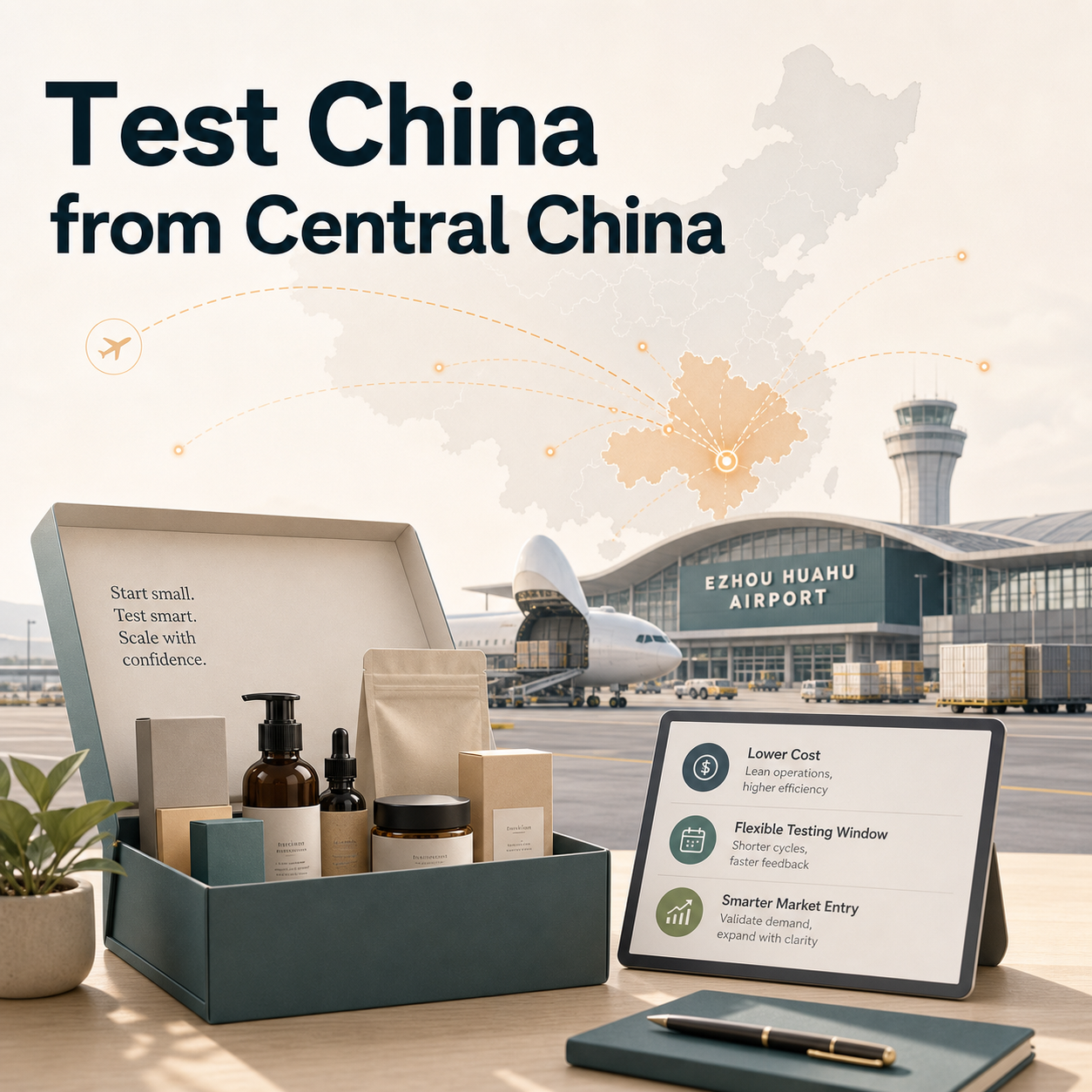
But they are also crowded, expensive, and difficult for smaller brands that do not yet know whether Chinese buyers will care about the product. Central China should not be treated as a replacement for the coastal entry points. It can be treated as a testing window: a place to bring product samples into China, show them to relevant buyers or channels, collect signals, and decide the next step with less pressure.
The data behind the opportunity
The logic is not only geographic. It is also about consumer scale, ecommerce habits, import movement, and logistics access.
China consumer marketRMB 50.1 trillion retail sales in 2025
Hubei consumer marketRMB 2.79 trillion retail sales in 2025
Wuhan cityRMB 901.4 billion retail sales in 2025
Hubei online retailRMB 556.7 billion in 2025
Hubei trade scaleRMB 834.0 billion total imports and exports in 2025
Huahu Airport roleCargo-focused airport with expanding domestic and international route coverage
These figures do not prove that every overseas product will succeed in Hubei or Central China. They show something more practical: the region is large enough to generate real feedback, connected enough to move samples and parcels, and still less saturated than China's first-tier coastal brand battlegrounds.
Why coastal cities are not always the best first test
Shanghai, Shenzhen, Guangzhou, and Hangzhou are often the right cities for large brands, national distributors, major ecommerce teams, and mature China strategies. But an overseas SME may face a different problem.
- Listing, marketing, agency, and channel costs can rise before the product-market fit is clear.
- Popular categories are already crowded with local and international brands.
- Initial feedback can be distorted by premium-city expectations, expensive retail environments, or platform competition.
- The first China conversation can become too big: distributor, platform store, compliance, campaign, inventory, pricing, and operations all at once.
For a smaller brand, the smarter first question may be: can the product create interest with real Chinese buyers before we spend heavily on China entry?
What Central China can offer
Central China is not a blank market. Hubei has a large provincial consumer base, Wuhan is a major commercial city, and regional ecommerce, livestreaming, local retail, community channels, and specialty-product communities are still developing.
Less crowded first signal
Overseas niche products may face lower direct visibility competition than in the most saturated coastal markets.
Large enough to learn
Hubei and Wuhan have enough consumption scale to support meaningful product feedback, not only casual opinions.
Growing digital channels
Online retail, livestreaming, community retail, and local ecommerce paths give products more than one feedback route.
Lower-pressure entry
A brand can start with samples, small batches, and feedback records before committing to a distributor or platform launch.
Where Huahu Airport fits
Ezhou Huahu Airport matters because physical flow still matters. China market entry is not only a marketing question. Products, samples, review units, display kits, replacement items, and small batches all have to move through a real network.
Huahu gives Central China a stronger cargo and parcel conversation. Public reports describe it as a professional cargo hub with expanding domestic and international routes, and Ezhou has also been positioned around airport economy, cross-border ecommerce, and bonded-logistics scenarios.
For overseas SMEs, this does not mean every product should use air cargo, or that Huahu replaces coastal logistics. The more useful point is that Central China now has a clearer physical gateway. That makes the region more credible as a test location, not only as an inland consumer market.
A practical testing model
A Central China test should be small, controlled, and recordable. It should not pretend to be a full China launch.
Step 1Bring samples into China and create a clear product record
Step 2Show the product to selected buyers, channels, users, or communities
Step 3Collect feedback on packaging, pricing, quality, use case, and category fit
Step 4Decide whether to revise, stop, test again, or prepare for a larger market step
This type of test is useful for specialty consumer products, non-regulated lifestyle goods, packaging samples, small hardware, display items, accessories, outdoor products, home goods, and other categories where real product handling changes the decision.
What overseas brands should measure
The goal is not to collect vague praise. A good market test should produce usable signals.
- Can people understand what the product is without a long explanation?
- Does the packaging communicate value in a Chinese context?
- Is the price expectation far below the overseas brand's target price?
- Which channels react better: ecommerce, livestream, local retail, community groups, professional buyers, or niche users?
- What needs localization: language, size, plug, flavor, formula, color, instructions, bundle, or claim wording?
- Is the product interesting enough to justify a second sample round or a small pilot batch?
Where China Sample Desk fits
China Sample Desk is not an importer, distributor, customs broker, freight forwarder, or sales agency. The role is narrower: help overseas teams make the sample stage more visible before bigger China decisions.
For this type of market test, that can mean receiving product samples in China, creating photo and condition records, preparing product cards, organizing a simple review path, collecting structured feedback, and helping the brand see whether the next step is worth discussing.
The value is not a promise that China will buy the product. The value is a clearer early read before the brand spends money on a larger entry path.
Discuss a China Sample Test
When this approach is not enough
A Central China sample test is not a substitute for regulated import work, product registration, customs classification, trademark review, national distribution, lab testing, or full ecommerce operations. Food, cosmetics, medical products, children's products, electronics, chemicals, and other regulated categories may require professional compliance work before any meaningful market test.
It is also not enough when the brand already has a confirmed China distributor, a national launch budget, and a mature local team. In that case, the test window may be too small. This model is mainly useful before those commitments are made.
Conclusion
Central China will not replace Shanghai, Shenzhen, Guangzhou, or Hangzhou. It does not need to.
Its value is different. For overseas SMEs, Hubei and Ezhou Huahu Airport can support a more flexible first step: bring the product into China, test it with real people and channels, learn from the response, and decide whether the product deserves a bigger China strategy.
For many brands, China should not begin with a heavy launch. It should begin with a controlled test.
Sources and scope notes
Data in this article is used for market context, not as a forecast for any specific product category. Figures can change by year and category, and product suitability depends on compliance, price, positioning, channel fit, and local feedback.