Short answer
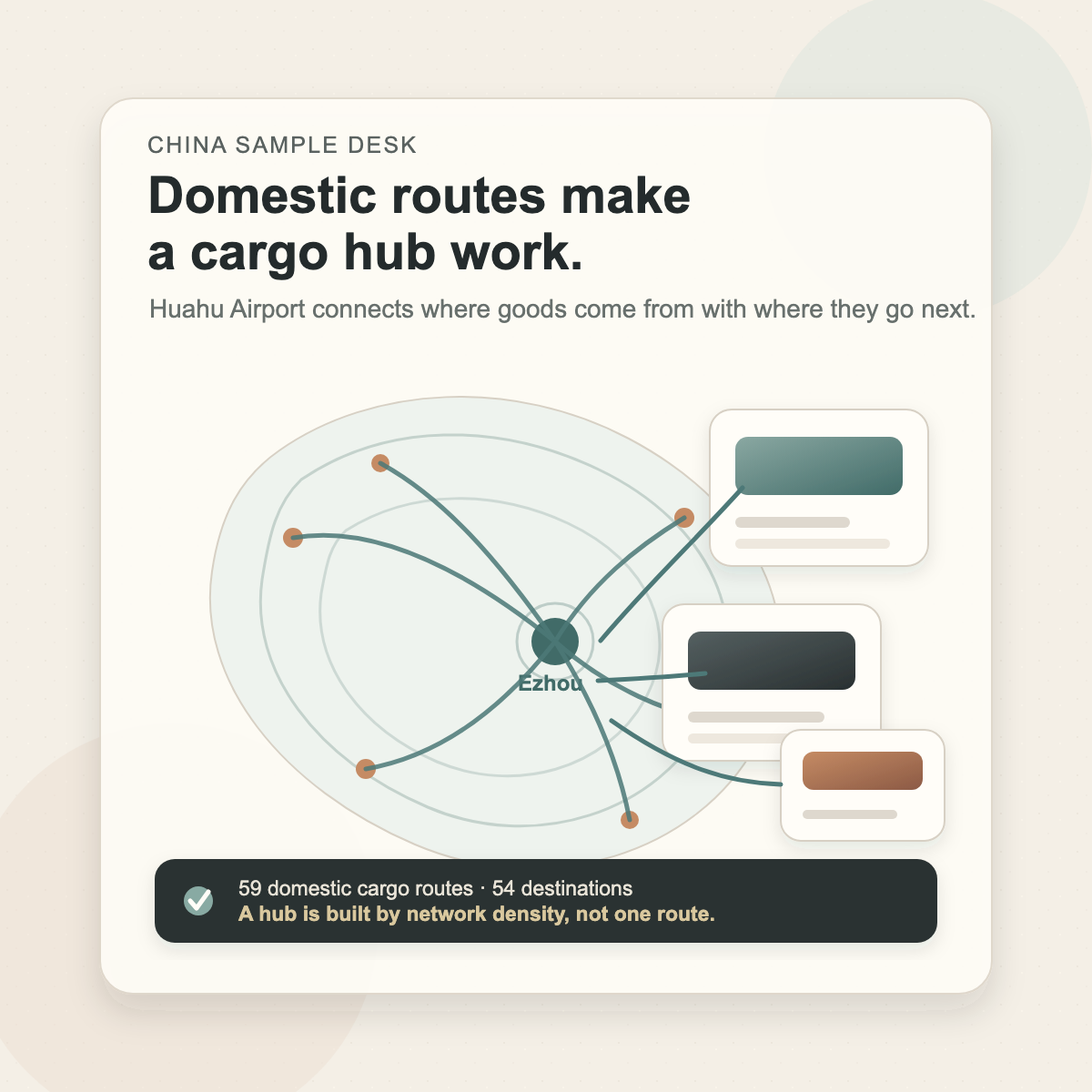
Huahu Airport's domestic cargo route network is one of the clearest reasons it matters as a cargo hub. Public reporting says the airport had 59 domestic cargo routes covering 54 domestic destinations by 2025, with coverage across China's provincial-level regions.
For overseas buyers, that does not mean every sample or shipment should move by air. It means Central China has a stronger network for gathering goods, moving time-sensitive samples, connecting small batches, and linking domestic supply with international cargo routes.
Why domestic routes matter more than they look
International cargo routes are easier to notice. They sound bigger, and they are easier to turn into headlines. But a cargo hub also needs domestic density.
Domestic routes answer a different question: where does the cargo come from before it goes out?
If cargo from Hubei, Central China, the Yangtze River Delta, the Pearl River Delta, North China, Southwest China, and other regions can enter the same hub with regularity, then the airport is no longer only serving its local city. It becomes a gathering point.
That is the real meaning of a hub. It connects many origins with many next steps.
Routes are one layer. Frequency is another.
A route map shows coverage. Flight frequency shows whether the network can actually support repeated business.
For cargo, a route that operates regularly is more valuable than a route that exists only on paper. Frequent flights give suppliers, logistics teams, ecommerce operators, and buyers more practical options for timing, consolidation, revision, and urgent movement.
This is especially relevant for sample-stage work because samples are rarely perfect the first time. A buyer may need a first sample, a revised sample, a packaging version, a small batch, or a comparison sample from another supplier. A denser air-cargo network can reduce some of the waiting and routing friction around those steps.
What this means for overseas buyers
For overseas buyers, the domestic network matters in a practical way. It can make Central China easier to include in early sourcing and sample-stage decisions.
- Samples from different regions can be routed into a stronger cargo node before the next movement.
- Suppliers in Hubei and nearby provinces can be evaluated with better logistics context.
- Urgent revised samples or small test batches may have more movement options than before.
- Air-cargo connectivity can make inland suppliers feel less disconnected from overseas buyers.
The point is not to turn every sample into an air shipment. The point is that a denser network gives buyers more ways to plan when speed, timing, or coordination matters.
What this means for suppliers
For suppliers in Hubei and Central China, Huahu Airport changes the location story.
For a long time, inland suppliers often had to explain themselves against coastal suppliers. The question was simple: are you too far from the port?
Air cargo does not replace sea freight. But it changes part of the conversation. If a supplier works with samples, revised products, urgent parts, ecommerce goods, lightweight products, or small test batches, domestic air-cargo access can become a useful part of the service story.
Suppliers should still be careful. A strong airport does not replace clear sample records, correct labels, stable packaging, honest revision notes, or basic quality discipline. Infrastructure supports trust. It does not create trust by itself.
Why this matters for sample-stage decisions
Sample-stage work is usually slower and messier than people expect. Different suppliers ship on different days. Labels may be unclear. Packaging may differ from what was promised. A buyer may need to compare several versions before deciding what to do next.
A stronger domestic cargo hub does not solve all of that. But it can make the physical side of the work easier to organize.
Receiving
Samples from different suppliers can be gathered into a clearer China-side workflow before being compared or forwarded.
Revision
When a sample needs a second version, better network options can reduce some back-and-forth friction.
Small batches
For trial orders or small urgent batches, air-cargo access can matter more than it does for standard bulk orders.
Regional comparison
Buyers can compare inland supplier options with a more realistic view of how goods can move.
What the network does not prove
The route network does not prove that a supplier is good. It does not prove that a sample matches bulk production. It does not replace factory due diligence, product testing, inspection, certification review, or commercial negotiation.
It only tells us that the physical movement environment is changing. That matters, but it is still only one layer of the decision.
How China Sample Desk reads this
China Sample Desk is based in Hubei, so Huahu Airport is part of our regional context. But we do not read it as a simple shipping slogan.
We read it as a sign that Central China is becoming a more practical place for sample-stage work: receiving samples, recording visible details, comparing supplier samples, asking for revisions, and preparing clearer next-step decisions.
For overseas buyers, the important question is not only "How fast can it ship?" A better question is "Can we build enough sample evidence before making the bigger decision?"
Start a Sample Project
Sources and scope notes
This article uses public reporting on Huahu Airport's domestic cargo route network, cargo-hub development, and air-cargo performance. It is written for overseas buyers and suppliers as a sample-stage and regional-supply-chain orientation, not as a full aviation operations analysis.