Short answer
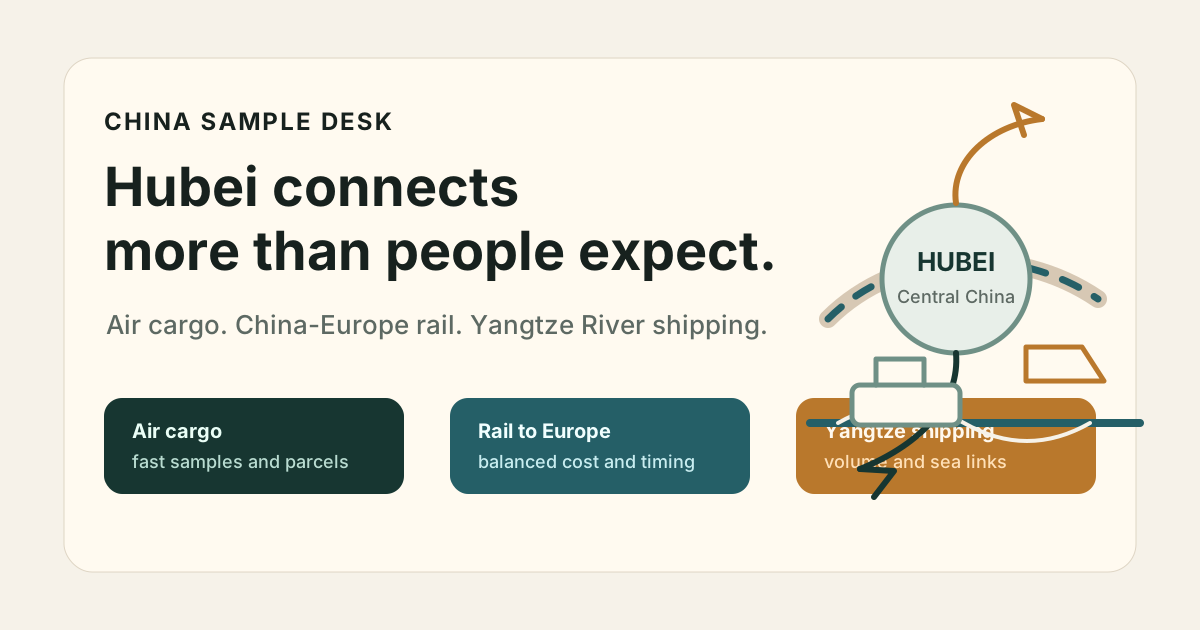
Hubei is often viewed as an inland province. That is true geographically, but incomplete commercially. For overseas buyers, Hubei should be read as a Central China logistics and supply-chain node with several movement options: air cargo for speed, rail for Eurasian land routes, Yangtze River shipping for volume, and road connections for regional collection and distribution.
This matters because not every product, sample, or shipment needs the same route. A revised sample, a small urgent batch, a pallet of event materials, machinery parts, ecommerce parcels, industrial components, and bulk container goods all have different cost, time, and handling requirements.
One province, several transport layers
Hubei's advantage is not one single route. It is the combination.
Air cargoEzhou Huahu Airport for time-sensitive cargo, parcels, samples, ecommerce, and high-value goods
Rail to EuropeChina-Europe freight trains from Wuhan for Eurasian trade with a cost-time balance between air and sea
Yangtze River shippingWuhan Yangluo Port and river-sea links for container volume and international shipping connections
Road networkRegional supplier collection, warehouse transfer, port/airport access, and sample consolidation around Central China
The practical value is flexibility. Hubei can connect inland factories, surrounding provincial industrial belts, coastal routes, European rail corridors, and river-sea shipping paths.
Air cargo: speed and network density
Ezhou Huahu Airport has made Hubei more visible in international cargo discussions. Public reports describe it as Asia's largest professional cargo airport, with more than 100 domestic and international cargo routes and fast growth in cargo throughput since opening.
For overseas buyers, air cargo is not only about large shipments. It also matters for urgent samples, revised samples, spare parts, event materials, ecommerce parcels, high-value components, and time-sensitive small batches.
- Use air when timing matters more than transport cost.
- Use air when a missing or revised sample blocks a decision.
- Use air when a small batch needs to reach a buyer, distributor, event, or test channel quickly.
- Do not use air blindly for bulky, low-margin, or non-urgent goods.
Rail: a land bridge for Europe and Eurasia
China-Europe freight trains from Wuhan give Hubei another option. Rail is slower than air but often faster than sea, and it can be useful for industrial goods, components, cross-border ecommerce, machinery parts, building materials, and shipments where timing matters but air freight is too expensive.
Official and media reports have described the Wuhan China-Europe train network as covering dozens of cross-border routes and reaching many countries and cities across Eurasia. In 2025, reported Wuhan China-Europe train operations continued to grow, with figures such as 902 trains under Hankou Customs supervision and more than 96,000 TEUs reported by Chinese media.
For buyers serving Europe, Central Asia, or Eurasian markets, this land route can change the way they think about Central China. It is not only a production region. It can also be a gateway into inland international corridors.
Yangtze River shipping: volume and sea access
The Yangtze River gives Hubei a different kind of logistics strength. Wuhan Yangluo Port connects inland Hubei with the Yangtze River shipping system and onward sea routes. Public reports have described Yangluo as a leading container port in the middle and upper reaches of the Yangtze, with container throughput above two million TEUs in recent years and a growing multimodal network.
River shipping is not the answer for every sample-stage need. But it matters for volume, containers, less urgent goods, heavy or bulky products, and shipments where cost control matters more than speed.
- Use river-sea links for larger batches and containerized cargo.
- Use multimodal river and rail links when cargo needs to move between inland and international corridors.
- Use air or express for small urgent samples instead of forcing slow-volume routes.
Why this matters for samples and small batches
China Sample Desk looks at logistics from a sample-stage perspective. The question is not only "Can goods move?" The question is "Which route fits the decision we need to make?"
Revised sample
Usually needs fast receiving, visible check, and air or express movement if the buyer is waiting.
Supplier comparison
Several domestic parcels may be collected into one China-side point before forwarding or review.
Event materials
Flags, backdrops, display stands, and spare parts may need early sample checks plus urgent backup shipping options.
Industrial components
Small parts may start with air samples, then move to rail or river-sea routes once the buyer commits to larger batches.
The underestimated Central China supply chain
Many overseas buyers still search China through a coastal map: Guangdong, Zhejiang, Jiangsu, Shanghai, Shenzhen, Guangzhou, Ningbo, Yiwu. Those places are important. But the Central China supply chain is often underestimated or simply not searched deeply enough.
Hubei and nearby provinces connect automotive parts, optical electronics, textiles, packaging, building materials, machinery, medical supplies, food processing, display materials, consumer goods accessories, and industrial components. The advantage is not that every category is stronger than the coast. The advantage is that there may be alternative sample sources, backup suppliers, and overlooked product clusters within reach of a more connected logistics network.
For overseas buyers, this creates a practical question: before assuming that only coastal suppliers can support a category, is there a Central China sample route worth testing?
How to choose the right transport logic
Different needs should use different routes.
Fast decisionAir cargo or express after China-side sample record
Balanced Europe routeChina-Europe rail when timing matters but air is too expensive
Volume and costYangtze river-sea shipping for containers and larger batches
Regional comparisonRoad collection into a China-side sample point before forwarding
The mistake is to treat logistics as a single question. The better approach is to match the route to the business decision: sample review, urgent replacement, pilot batch, production order, or market test.
Where China Sample Desk fits
China Sample Desk is not a freight forwarder, customs broker, rail operator, port agent, or transport company. We do not sell route promises. Our work sits earlier: making the sample stage clearer before goods move into a bigger shipment or market-entry decision.
That can mean receiving samples from several suppliers, checking visible details, recording packing and labels, comparing options, organizing backup samples, and helping the overseas team decide whether an item should be revised, forwarded, held, or used for a small test.
Hubei's transport network matters because it gives Central China more practical routes after that sample decision is made.
Start a Sample Project
Conclusion
Hubei is not only an inland location. It is a Central China transport node with air, rail, river, and road options that fit different shipment needs.
For overseas buyers, the more important point is not to memorize every route. It is to stop reading China only through coastal geography. Central China has both industrial depth and transport access. That combination makes it more relevant for sample-stage work, backup sourcing, small-batch testing, and selected international trade than many buyers expect.
Sources and scope notes
This article is a regional logistics and sample-stage note, not a freight quote or route guarantee. Actual shipping options depend on carrier, cargo type, destination, customs, service level, seasonality, and commercial contract.