Short answer
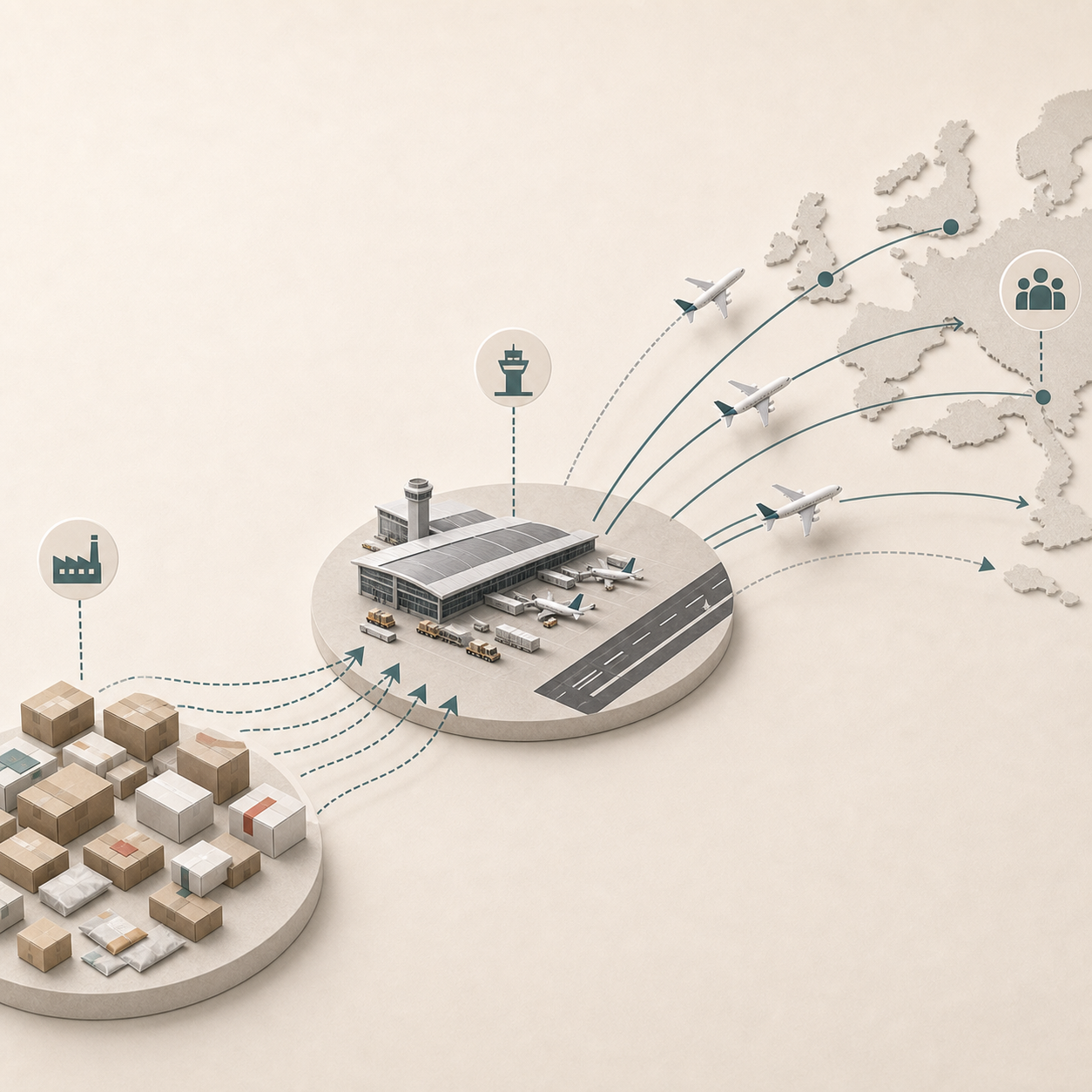
Some Shenzhen-origin parcels and cargo may not move directly from Shenzhen to Europe. Depending on carrier network design, flight schedules, shipment type, and consolidation needs, goods can first move into a cargo hub such as Ezhou Huahu Airport, then depart through international or onward routes.
This is not necessarily a detour. It is how a hub-and-spoke cargo network can gather dispersed volume, support higher route frequency, improve aircraft load factors, and make long-haul cargo routes more stable.
Why a direct line can be misleading
From a buyer's point of view, the route looks simple:
Simple viewShenzhen to Europe
Hub-network viewShenzhen to Ezhou hub to Europe
ReasonGather volume, sort cargo, and feed stable trunk routes
Buyer takeawayWatch the network, not only the origin city
International cargo does not only depend on where a package starts. It also depends on where the carrier can gather enough volume, how often aircraft depart, which routes are stable, and which hub can connect multiple origins to multiple destinations.
What a cargo hub actually does
A hub is useful because it turns many scattered shipments into a more organized network.
Gather
Parcels from different cities and suppliers can be routed into one stronger cargo node.
Sort
Cargo can be identified, grouped, and prepared for the next flight or route segment.
Feed
Consolidated cargo volume helps support trunk routes that need stable demand.
Repeat
Higher and more predictable frequency makes the network more practical for time-sensitive goods.
Why Ezhou Huahu Airport is part of this conversation
Ezhou Huahu Airport was built as a dedicated cargo-focused airport in Central China. Its value is not only that it sits in Hubei. Its value is that it can act as a node where domestic cargo, cross-border ecommerce goods, small parcels, time-sensitive cargo, and selected international flows are gathered and redistributed.
Public reports describe Huahu Airport as a professional cargo hub with expanding domestic and international route coverage. That makes it relevant even when the original supplier or parcel is outside Hubei, including cargo originating from coastal manufacturing and ecommerce regions.
Why this matters for overseas buyers
For overseas buyers, the point is not to memorize every cargo route. The point is to understand that a stronger inland hub can change the movement logic around samples and small shipments.
- A shipment's origin city does not always explain the full route.
- Higher-frequency hub networks can make movement more predictable than isolated one-off routes.
- Samples, revised samples, ecommerce parcels, and small batches often depend on network density, not only factory location.
- Central China should be read as part of a national cargo network, not only as an inland manufacturing region.
Why this matters for suppliers
For suppliers, hub logic affects how a location can be explained to overseas buyers.
A supplier in Shenzhen may still use a network that routes cargo through a central hub. A supplier in Hubei or nearby provinces may benefit from being closer to that hub. A supplier farther away may still be connected if the domestic cargo route network is dense enough.
But this does not replace the basics. Good sample work still needs correct labels, clear packing, accurate quantities, visible-condition discipline, and fast response when a buyer asks for a revision.
The role of frequency
A cargo hub becomes more useful when routes are repeated often enough to support real business. Frequency gives carriers and shippers more timing options. It also makes the network less dependent on a single fragile movement path.
For samples and small batches, this matters because timing is part of the decision. A late revised sample may delay a buyer's product decision. A missing accessory may require a second shipment. A better route network cannot solve every problem, but it can reduce some of the friction around moving small, time-sensitive items.
What hub logic does not mean
It does not mean every Shenzhen package must pass through Ezhou. It does not mean every cargo route is faster through a hub. It does not mean air cargo is the right choice for every product.
Carrier networks change by shipment type, destination, price level, flight capacity, customs arrangement, and commercial contract. The useful point is broader: in modern cargo networks, the most important route is often not the straightest line. It is the most reliable network path.
How China Sample Desk reads this
China Sample Desk looks at Huahu Airport from a sample-stage perspective. We are not a freight forwarder, and we do not sell route promises. But the presence of a stronger cargo hub in Hubei matters for how overseas buyers think about sample movement, regional supplier comparison, and small-batch planning.
The practical question is not only "Where is the factory?" It is also "Where can the goods be gathered, recorded, compared, revised, and moved with a clearer next step?"
Start a Sample Project
Sources and scope notes
This article explains cargo-hub logic for overseas buyers and suppliers. Specific shipment routing depends on the carrier, service level, destination, flight schedule, customs process, and commercial arrangement.