Short answer
For small teams, the AI hardware opportunity is usually not in GPUs, advanced chips, lithography machines, or complete robots. Those areas require heavy capital, deep R&D, certification, supply-chain control, and long after-sales responsibility.
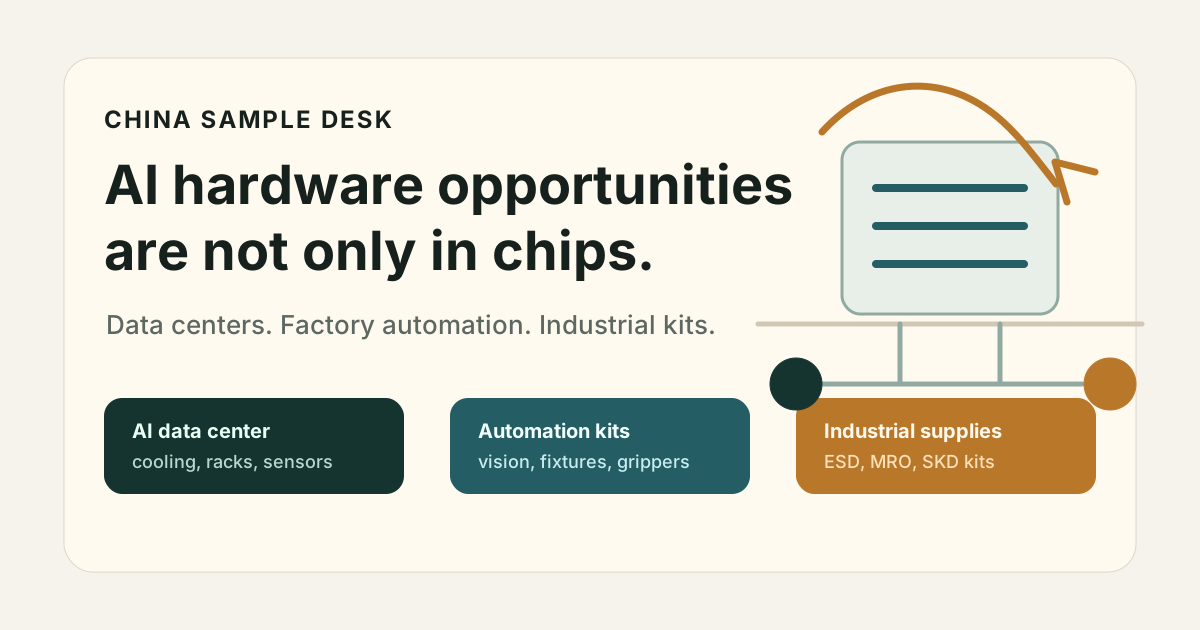
The more practical opportunity sits around the expansion of AI infrastructure: data-center accessories, liquid-cooling support parts, rack and cable management, factory automation kits, machine-vision modules, ESD and cleanroom consumables, MRO supplies, fixtures, industrial training kits, and SKD or CKD support packages for local assembly.
Why the opportunity exists
AI is turning hardware demand from a consumer-electronics story into an industrial-infrastructure story.
Data centersAI workloads are increasing demand for power, cooling, racks, sensors, and maintenance tools.
Sovereign AIGovernments are funding local compute, semiconductor, and AI-factory capacity.
Manufacturing resetSupply chains are becoming more regional, redundant, and automation-heavy.
New factoriesElectronics, industrial, and energy projects need fixtures, ESD, MRO, tools, training, and spare parts.
Gartner has estimated that global data-center electricity consumption will keep rising sharply with AI demand. The IEA also expects data-center electricity use to grow materially by 2030. At the same time, the United States, the European Union, India, Vietnam, and other regions are using policy and investment programs to build more local AI, semiconductor, and electronics capacity.
The result is simple: even when the core chips are made by a few large companies, many physical support products are needed around them.
Seven hardware areas worth watching
Small teams should look for products that are useful, repeatable, easier to sample, and easier to explain in a specific industrial scenario.
1. AI data-center accessories
Liquid-cooling hoses, quick connectors, leak-detection cables, rack blanking panels, airflow guides, cable labels, sensor mounts, spare-parts kits, and inspection tools.
2. Machine-vision kits
Industrial cameras, lenses, lights, brackets, calibration boards, edge boxes, rejection mechanisms, and small AI inspection packages.
3. Robot end tooling
Grippers, suction cups, quick-change plates, fixtures, harness protection, mounting bases, and small conveyor or sorting accessories.
4. ESD and SMT support
Anti-static mats, trays, racks, PCB carriers, reel storage, stencil storage, nozzle-cleaning tools, solder-paste handling, and traceability labels.
5. Factory MRO and workstations
Workbenches, tool cabinets, material racks, visual boards, picking carts, torque tools, measuring tools, cable protection, brackets, casters, and guards.
6. Energy and maintenance tools
Low-voltage current sensors, temperature and humidity sensors, thermal cameras, leak detection, vibration sensors, inspection kits, and energy-monitoring gateways.
7. Training and lab kits
PLC trainers, machine-vision training kits, robot education kits, ESD practice kits, semiconductor handling demos, and AI defect-detection lab boxes.
What to avoid at the beginning
The easiest mistake is to chase the biggest words in the AI supply chain. A small team usually should not start with UPS systems, high-voltage switchgear, transformers, fire-protection systems, core PDUs, GPU servers, advanced semiconductor equipment, or complete industrial robots.
Those areas may be attractive, but they carry heavier certification, liability, financing, engineering, and support requirements. For early product validation, lower-risk accessories, tools, sensors, fixtures, consumables, and kits are usually more realistic.
The best product is often a scenario package
Small teams should not start by saying, "We sell industrial cameras" or "We sell ESD products." That is too broad.
Weak positioningIndustrial camera supplier
Better positioningAI inspection kit for missing screws, surface scratches, label errors, or packaging defects
Weak positioningESD product supplier
Better positioningESD workstation starter pack for new SMT workshops in India, Vietnam, or Mexico
Weak positioningData-center parts supplier
Better positioningLiquid-cooling rack maintenance kit with leak detection, tube labels, spare connectors, and inspection tools
A scenario package is easier for a buyer to understand, easier to sample, easier to compare, and easier to pilot.
Three practical entry ideas
1. AI inspection starter kit
Package an industrial camera, lens, light, bracket, edge-computing box, basic detection software, and a simple rejection or alert mechanism. The first customers could be factories checking plastic defects, metal-surface marks, packaging misses, label errors, screw absence, textile stains, or assembly gaps.
2. AI data-center maintenance accessory kit
Focus on liquid-cooling and rack operations: leak detection, quick connectors, hose labels, blanking panels, cable management, sensor brackets, spare-parts trays, inspection records, and maintenance tools. The customer is not the hyperscaler directly. It may be a regional integrator, data-center contractor, operations team, or cooling retrofit provider.
3. ESD and workstation starter pack for new electronics factories
Combine anti-static mats, wrist straps, ESD boxes, PCB racks, reel racks, tool cabinets, labels, barcode accessories, test fixtures, and work instructions. This is especially relevant where electronics manufacturing is expanding but local peripheral supply chains are still incomplete.
How to validate before building inventory
This is where the sample stage matters. A small team does not need to buy containers of parts before learning what the market wants. It can build a small package, create clear photos and specifications, send samples to selected buyers, and record feedback.
- Define the exact industrial scenario and problem.
- Build one sample kit instead of a broad catalog.
- Record the bill of materials, dimensions, compatibility notes, certifications, and handling limits.
- Ask buyers to compare the sample against their current process or supplier.
- Capture questions around installation, safety, replacement parts, compliance, and after-sales expectations.
- Revise the kit before scaling marketing, inventory, or distributor outreach.
Where China Sample Desk fits
China Sample Desk can support this kind of early-stage product validation by helping teams receive, organize, photograph, compare, and record physical samples in China before larger sourcing or market-entry decisions.
For AI hardware accessory projects, the useful work is often very practical: receive parts from several Chinese suppliers, assemble a sample kit, photograph details, check visible differences, prepare a comparison sheet, record packaging and labeling, and help the overseas team decide which version is ready for buyer feedback.
We do not replace certification labs, engineering consultants, import brokers, or full sourcing agents. The role is to make the sample stage clearer before the team commits to larger orders, distributor conversations, or pilot projects.
Start a Sample Project
Conclusion
AI hardware does not only mean chips. For small teams, the opportunity is often in the physical support layer: the hoses, brackets, sensors, racks, fixtures, labels, workstations, ESD supplies, inspection kits, MRO packs, and training tools that make AI infrastructure and new factories work.
The right question is not "Can we build the next GPU?" It is "Which narrow industrial problem can we package, sample, test, and improve faster than a large supplier?"
Sources and scope notes
This article is a market-opportunity note, not investment advice or a technical certification guide. Product feasibility depends on category, target country, safety requirements, buyer process, certification, and after-sales support.