Short answer
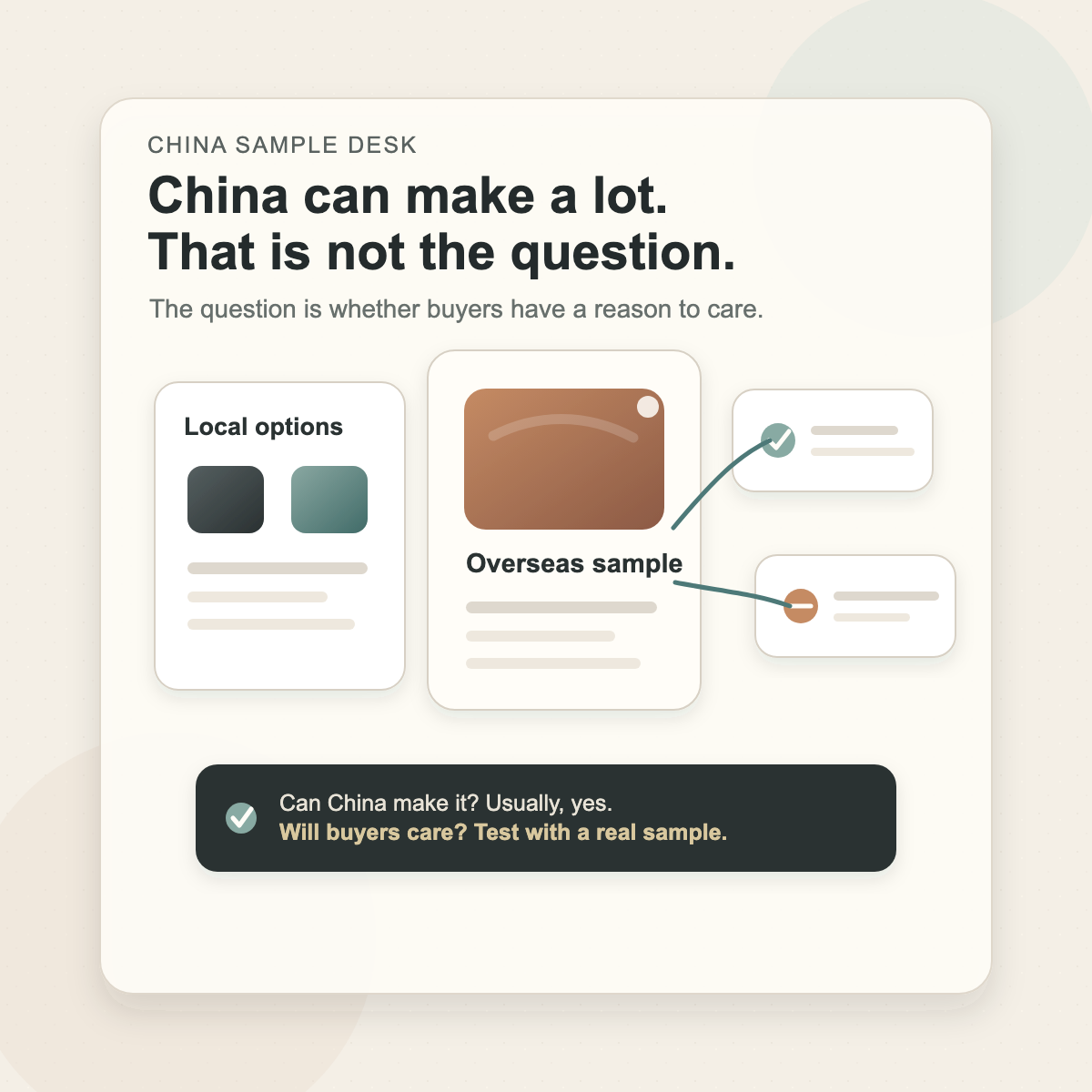
A common mistake is to ask, "Can China make this product?" In many categories, the answer is yes. China has deep manufacturing capacity, fast product iteration, strong supplier networks, and highly competitive local alternatives.
But that is not the end of the question. The more useful market-entry question is: "Is there a reason Chinese buyers would understand, compare, trust, prefer, or pay attention to this overseas product?"
Why the manufacturing question is incomplete
China being a manufacturing power does not mean China has no demand for overseas products. It means overseas suppliers need a sharper reason to enter.
If a product is ordinary, easily copied, poorly explained, weakly packaged, or priced without a clear reason, the market may ignore it. If the product has a strong use case, a trusted origin story, a niche application, a better material, or a design that solves a real problem, then the conversation becomes different.
The issue is rarely whether something can be produced locally. The issue is whether the product creates a reason for attention.
Reasons Chinese buyers may still care
Material or performance
The product uses a material, formula, technical standard, or performance profile that feels meaningfully different from local options.
Brand trust or origin
Some categories are influenced by country-of-origin perception, professional trust, safety concerns, lifestyle positioning, or long-term brand credibility.
Niche use case
A product may not be mass-market, but it can still fit a specific professional, industrial, lifestyle, health, food, sports, pet, or education scenario.
Design and presentation
Packaging, product language, visual style, and user experience may help a product stand apart from local alternatives.
Start with a sample, not a conclusion
Market analysis often becomes too broad too early. Overseas suppliers may hear one of two simple answers: "China needs this" or "China does not need this." Both can be misleading.
A more grounded first step is to put a real sample in front of China-side contacts and observe the response. Not to prove the whole market. Not to promise sales. Just to find the first layer of understanding.
- Can people explain what the product is?
- Do they compare it with a local alternative?
- Do they ask about price, safety, usage, size, origin, or packaging?
- Does the Chinese product story make sense?
- Is the product seen as ordinary, premium, confusing, unnecessary, or interesting?
What sample feedback can reveal
UnderstandingDo local contacts quickly understand what the product is and who it is for?
ComparisonWhat Chinese products do they naturally compare it against?
ObjectionWhat questions appear around price, trust, compliance, packaging, use case, or channel fit?
PositioningDoes the product feel mass-market, niche, premium, technical, lifestyle, or unclear?
What sample feedback cannot prove
A sample cannot prove market demand. It cannot guarantee distributor interest, ecommerce conversion, KOL cooperation, regulatory permission, import approval, or long-term sales.
That boundary matters. The value of sample feedback is not certainty. The value is that it can challenge assumptions before larger spending begins.
How China Sample Desk can help
China Sample Desk helps overseas suppliers use real product samples to collect early China-side signals before bigger market-entry decisions.
We can help receive samples in China, prepare a concise Chinese product card, show the sample to suitable contacts when appropriate, record practical questions and reactions, and summarize what the response may mean for the next step.
We do not promise sales channels or market acceptance. We help suppliers learn what the sample reveals before they commit to more expensive market-entry work.
Start Supplier Showcase
Related reading